
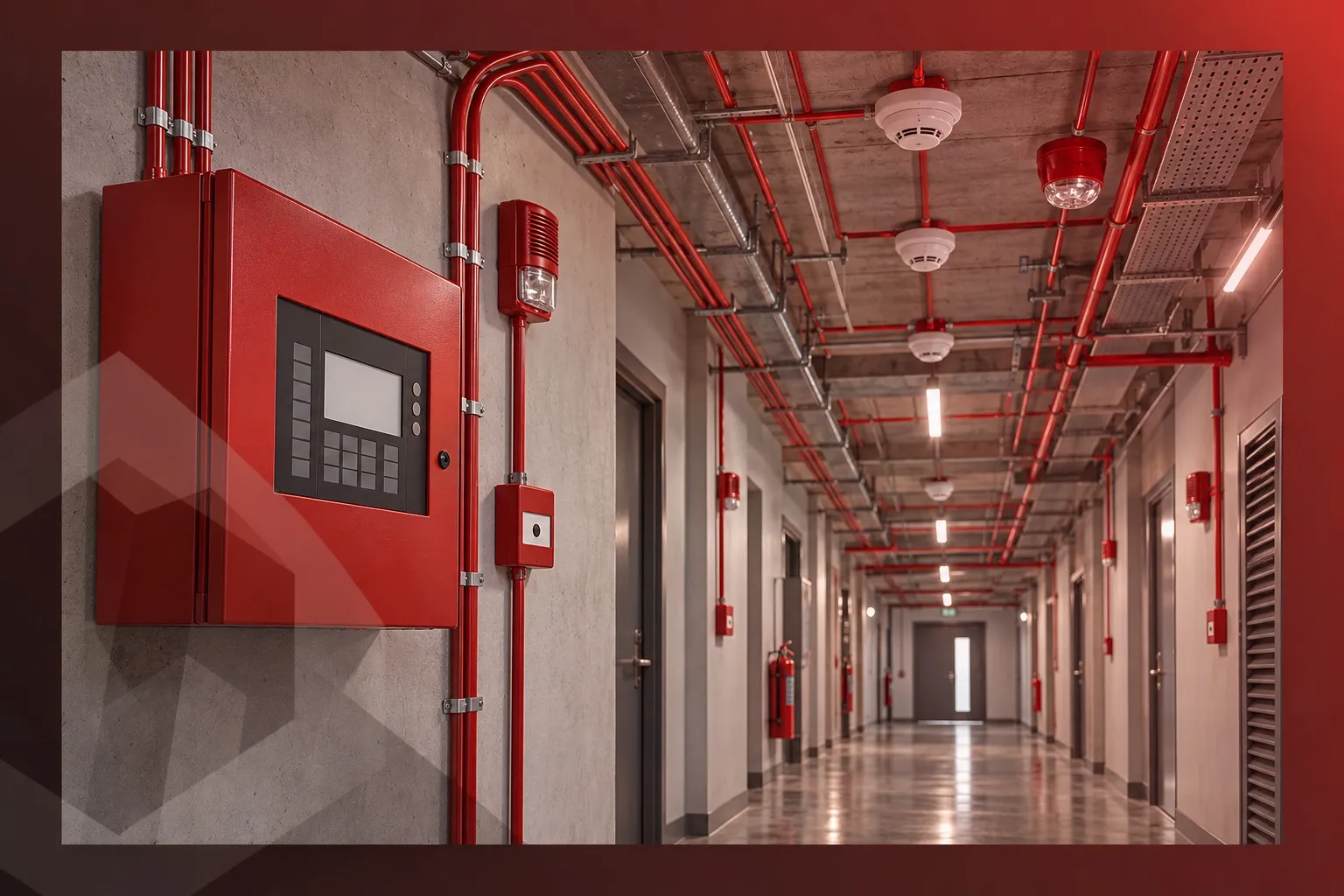
Fire alarm system in facilities
A comprehensive guide by I-CON on fire alarm system design and fire alarm installation for commercial and residential facilities. Learn how to construct a reliable fire alarm network, compare addressable vs. conventional systems, and partner with top fire fighting and alarm companies in Egypt.
A fire alarm system in any facility is a fundamental pillar of its safety and protection architecture. The true challenge lies not just in reacting to a fire, but in detecting it rapidly and dealing with it before it turns into a life-threatening, property-damaging disaster. An effective system enables early detection of hazards and broadcasts instant alerts so that appropriate measures can be taken in a timely manner.
The success of a system does not rely solely on the installation method of a single fire alarm device; it requires a well-engineered fire alarm network design, selection of optimal components, and precise execution by a professional contractor that matches the facility's nature and safety requirements.
In this article, we explore how to install a fire alarm, why it is critical, how to engineer a professional fire alarm system design, the primary safety standards to achieve, and how to select the best fire alarm companies in Egypt.
What Is a Facility Fire Alarm System?
A facility fire alarm system is a life-safety setup designed to detect fire at its earliest stages and transmit immediate warning signals to evacuate the premises, thereby minimizing risks and safeguarding lives and assets.
It comprises an interconnected group of devices and components that work in unison to detect fires and alert occupants. The fire alarm network design is tailored to the facility's area, usage, and required hazard protection level to ensure full coverage and rapid emergency response.
At I-CON MEP Solutions, we design and implement complete fire protection solutions tailored to each project's unique requirements—from initial needs assessment and network layout to supply, installation, testing, and commissioning. Contact us to design an integrated Fire Alarm and Firefighting system for your building.
How Does a Fire Alarm System Work?
A facility fire alarm system operates through four primary functions—Detection, Notification, Monitoring, and Control—working seamlessly together for early detection and rapid response:
- Detection: Smoke, heat, and flame detectors continuously monitor environmental conditions. Upon sensing abnormal shifts, they transmit signals to the control panel.
- Notification: The control panel receives the signal and activates notification appliances (sirens, bells, and strobes) to alert building occupants to the hazard.
- Monitoring: The system continuously tracks the health of its wiring and components, detecting faults or disruptions that could impair performance.
- Control and Integration: The alarm system can interface with other building management systems (such as HVAC, smoke extraction, elevators, and access control) to execute emergency protocols automatically.
Thus, a fire alarm system does not rely on an isolated device, but on an integrated network of detectors, notification appliances, and control panels working together to guarantee rapid detection and response.
Importance of Fire Alarm Systems in Facilities
A fire alarm system provides early hazard detection and an immediate response mechanism to protect lives and property, stemming the spread of fire before it escalates.
The value of an effective alarm system multiplies as operational activities diversify and potential fire risks increase. Early detection time is the single most critical factor in controlling fires and reducing financial and operational fallout.
Key benefits include:
- Life Safety: Issuing clear warnings when a fire is detected allows occupants to begin safe evacuation in time.
- Early Hazard Detection: Catching combustion indicators and smoke particles at the earliest stages before the fire spreads.
- Reducing Physical Property Damage: Minimizing structural damage to the building, machinery, and underlying infrastructure.
- Streamlining Evacuation Protocols: Instantly activating alerts that guide occupants safely along designated emergency exit routes.
- Integration with Safety Systems: Automatically triggering fire suppression systems, smoke control, elevator recall, and fire-door release.
- Regulatory Compliance: Achieving full compliance with local civil defense codes, engineering standards, and safety regulations.
At I-CON MEP Solutions, we apply engineering methodologies that transform standalone alarm hardware into a cohesive protection system, prioritizing maximum reliability and permanent operational readiness.
Best Facility Fire Alarm Systems from I-CON
The best fire alarm system is one that delivers early detection, swift response times, and full integration with the building's overall safety infrastructure.
There is no "one-size-fits-all" solution. Component selection depends on floor space, occupancy type, hazard classification, and code requirements. Key components include:
- Smoke Detectors: For sensing airborne smoke particles and detecting smoldering fires early.
- Heat Detectors: Ideal for environments where steam, dust, or ambient fumes make smoke detectors prone to false alarms.
- Flame Detectors: Used in specialized, high-risk environments requiring direct detection of naked flames or radiant energy.
- Audible & Visual Notification Devices: Horns, bells, and strobes that alert occupants across both visual and auditory spectrums.
- Fire Alarm Control Panels (FACP): The central hub that processes signals from detectors and manages alerting and monitoring functions.
Systems also differ by addressing protocol, categorized into Conventional Systems and Addressable Systems, with selection guided by facility size and operational complexity.
At I-CON MEP Solutions, we study every project's parameters before specifying components, delivering complete Fire Alarm solutions integrated within broader MEP and Firefighting frameworks.
Why Choose I-CON for Fire Alarm Installation?
At I-CON, we deliver fire alarm device installation solutions backed by specialized engineering expertise and meticulous planning to ensure an integrated system for every facility.
As one of the leading fire fighting and alarm companies in Egypt, I-CON MEP Solutions provides comprehensive services spanning needs assessment, network design, equipment supply, precision installation, testing, and system integration within the overall MEP layout.
Our key advantages include:
- Specialized MEP Expertise: Integrating fire alarm systems smoothly alongside electrical, mechanical, and safety infrastructure.
- Engineered Network Layouts: Analyzing facility architectural layouts to position devices and wiring routes for optimal coverage.
- Project-Specific Equipment Selection: Providing solutions tailored to residential, commercial, or industrial hazard levels.
- Precise Engineering Execution: Installing devices and field wiring carefully to ensure long-term system stability and easy maintenance.
- Interdisciplinary Coordination: Aligning fire alarm installation with other site works to avoid spatial and technical conflicts.
- Dedicated Engineering Team: Skilled engineers managing design, installation, and commissioning from start to finish.
- Complete System Testing & Handover: Conducting rigorous operational tests after installation to verify performance readiness.
- Tailored Infrastructure Solutions: Customizing each system to facility needs rather than relying on generic templates.
I-CON is recognized among the premier fire alarm companies in Egypt because we believe a successful system starts with deep spatial understanding and custom engineering design, ensuring high operational reliability.
How to Design a Fire Alarm System for Facilities
Designing a fire alarm system begins by assessing the facility's occupancy type, overall floor area, and hazard level, followed by selecting and positioning system components to guarantee early detection and effective warning coverage.
A complete fire alarm network design relies on several core components selected and distributed per project needs.
Main Components of a Facility Fire Alarm System
- Fire Alarm Control Panel (FACP): Serves as the system brain, receiving inputs from initiating devices and pinpointing alarm or fault locations.
- Initiating & Sensor Devices: Includes smoke, heat, and flame detectors that continuously scan for early fire indicators.
- Manual Call Points (Break Glass / Pull Stations): Allows manual triggering of an alarm upon visual detection of a fire.
- Notification Appliances: Sirens, chimes, bells, and strobes that broadcast warning alerts throughout the premises.
- Monitoring & Module Interfacing: Connects the alarm system to external systems like sprinklers, HVAC dampers, and BMS.
- Secondary Power Sources: Standby batteries and power units ensuring uninterrupted operation during main power outages.
Factors Governing Fire Alarm System Design
- Facility Usage & Occupancy Classification: Residential, commercial, and industrial sites carry different design criteria.
- Building Area & Compartmentation: Determines total device counts, spacing, and optimal coverage zones.
- Exit Routes & Evacuation Paths: Ensures warning alerts are clearly audible and visible along all egress routes.
- Hazard Nature: Spaces exposed to dust, moisture, or high thermal variations require specific sensor choices rather than standard smoke detectors.
- System Type Selection: Choosing between Addressable and Conventional systems based on project scale and complexity.
- Local Codes & Civil Defense Standards: Designing in full compliance with Egyptian Fire Codes, NFPA guidelines, and local authority requirements.
At I-CON MEP Solutions, we avoid cookie-cutter device layouts. We analyze architectural blueprints and operational needs, then design, install, test, and hand over a fully operational system integrated with Firefighting setups.
Fire Alarm Device Installation Process
The installation of a fire alarm device involves selecting the optimal physical position, wiring it into the central network, and running diagnostic tests to confirm operational readiness.
The installation process follows these systematic steps:
- Device Location Marking: Identifying exact mounting spots for detectors, call points, and strobes based on engineering drawings for maximum coverage.
- Wiring and Conduit Preparation: Running fire-rated cabling and containment routes back to the main control panel per design specifications.
- Mounting and Network Termination: Securely installing devices, terminating connections, and verifying signal continuity across the loop.
- Testing and System Commissioning: Conducting functional testing, alarm simulation, and signal verification to ensure full system responsiveness.
At I-CON MEP Solutions, we execute fire alarm device installation within a managed, end-to-end framework built for modern facilities.
Types of Fire Alarm Systems in Facilities
Fire alarm systems are categorized by their operating mechanisms and how accurately they locate an alarm event.
|
System Type |
Operating Mechanism |
Best Suited For |
|
Manual System |
Relies on human intervention to pull/activate an alarm upon sighting a fire |
Small premises or as a secondary manual backup |
|
Automatic System |
Uses smoke, heat, or flame sensors to detect fire and alarm automatically |
Most modern commercial and public facilities |
|
Conventional System |
Divides the building into zones; identifies the zone in alarm without pin-pointing the exact device |
Small to medium-sized projects with basic layouts |
|
Addressable System |
Pinpoints the exact individual detector or module sending the alarm signal |
Large, complex, multi-story, or high-risk facilities |
|
Smart / Intelligent System |
Provides advanced real-time monitoring, signal drift compensation, and system analysis |
High-spec facilities requiring central monitoring and automation |
I-CON MEP Solutions tailors system selections to facility area, risk profile, and operational needs, reinforcing our position among top fire fighting companies in Egypt.
Fire Alarm System Prices in Egypt & Cost Factors
Fire alarm device prices in Egypt vary based on the chosen technology, building area, total device count, and implementation requirements. Final project estimates are provided following a site audit and blueprint review.
Key factors influencing total cost include:
- Type of system (Conventional vs. Addressable vs. Wireless).
- Total floor space and compartmentation complexity.
- Component quality, brand certifications, and technical specifications.
- Design engineering, cabling installation, and execution labor.
- Contractor expertise and warranty offerings.
At I-CON MEP Solutions, we focus on delivering cost-engineered fire alarm solutions that balance strict life-safety protection with budget considerations.
Key Standards for Facility Fire Alarm Systems
Implementing a fire alarm system requires adherence to engineering codes that guarantee swift hazard detection and effective response:
- Compliance with Egyptian Fire Code & Civil Defense Regulations: Ensuring all design parameters meet national standards and local civil defense approval requirements.
- Pre-Design Facility Audits: Determining device layout, loop counts, and panel sizing based on architectural usage and risk levels.
- Selecting Certified Equipment: Utilizing UL/FM-listed or code-compliant control panels, sensors, and notification devices.
- Precise Spatial Distribution: Placing sensors within specified coverage radiuses to prevent dead zones and ensure quick detection.
- Inter-System Integration: Interfacing alarm panels with fire pumps, HVAC smoke dampers, and access control for synchronized emergency responses.
- Routine Inspection & Maintenance: Establishing regular testing schedules to ensure system integrity and battery standby readiness.
I-CON MEP Solutions designs and implements every system in accordance with these engineering guidelines, delivering reliable protection for your facility.
Difference Between Fire Alarm and Fire Fighting Systems
Fire alarm and fire fighting systems serve distinct yet complementary functions: fire alarms detect and notify, while fire fighting systems actively extinguish or control the blaze.
|
Feature |
Fire Alarm Systems |
Fire Fighting Systems |
|
Primary Function |
Detects fire indicators (smoke, heat) and issues instant warnings |
Extinguishes fires or suppresses their spread |
|
Operational Stage |
Activates at the earliest signs of combustion to initiate evacuation |
Activates automatically or manually when a fire breaks out |
|
Components |
Smoke/heat detectors, control panels, sirens, manual call points |
Sprinklers, fire pumps, hose reels, gas suppression systems |
|
Ultimate Goal |
Rapid hazard detection and evacuation time reduction |
Life and structural protection through active fire control |
At I-CON MEP Solutions, we integrate detection and suppression systems into a single safety solution for comprehensive protection.
Fire Alarm Equipment Supply and Installation
I-CON offers end-to-end fire alarm equipment supply and installation services, tailoring systems to the needs of diverse facilities.
Our scope covers equipment selection, network engineering, cable installation, device mounting, loop termination, system integration, and final testing.
I-CON: Premier Fire Alarm Company in Egypt
I-CON is a trusted provider among fire alarm companies in Egypt, offering integrated engineering design, equipment procurement, installation, and MEP coordination under one roof.
We deliver fire detection and safety solutions for diverse projects—from initial feasibility studies and blueprint layouts to installation, testing, and final civil defense commissioning.
Don't wait for an emergency to reveal vulnerabilities; safeguard your facility with a custom-engineered fire alarm system. Contact the I-CON MEP Solutions team today to consult with our engineers and build a safer, more reliable protection infrastructure for your project.
Frequently asked questions
Answers about this article and related topics.
An addressable system precisely identifies the location of the alarm device that detected the hazard, whereas a conventional (non-addressable) system identifies only the zone without pinpointing the specific device. Addressable systems are typically used in large facilities where rapid fire location identification is required, while conventional systems are suitable for smaller projects with simpler requirements.
A fire alarm panel should only be silenced or reset from the main Fire Alarm Control Panel (FACP) using authorized user keys or passcode access after inspecting the area and verifying the cause of the alarm. Individual devices should never be randomly disconnected, as this compromises the safety loop.